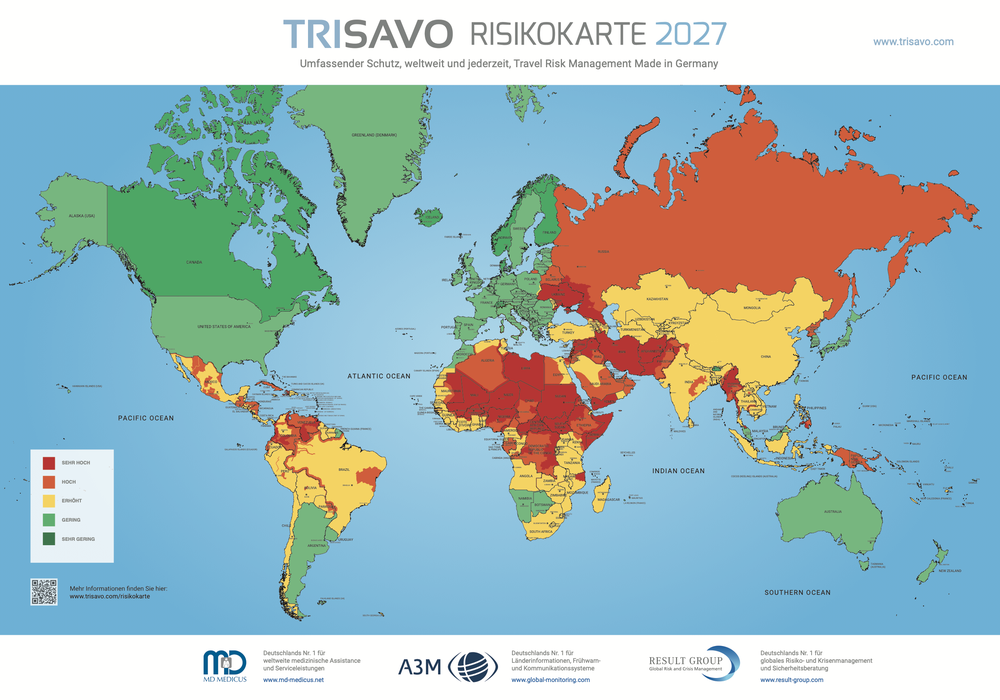
The TRISAVO Risk Map 2027 offers small and medium-sized enterprises, corporations, and business travelers a concise assessment of the security situation in the regions relevant to them. Our analysts take into account current conflicts, geopolitical tensions, and political developments that could affect international activities.
Power relations in the Near and Middle East
The military escalation between the US, Israel, and Iran in 2026 further strained the regional power balance in the Middle East. How relations between the regional powers develop and what role the US will play in the future will significantly determine the stability of the region in 2027.
The war against Ukraine and Europe's security
The further course of Russia's war of aggression against Ukraine and future European relations with Russia remain central factors for the European security order. Even a potential ceasefire would not necessarily reduce existing tensions; hybrid activities and attacks on critical infrastructure are likely to continue posing a challenge.
Regional conflicts in Africa
On the African continent, unresolved conflicts, political instability, and the interests of external actors are hindering the stabilization of entire regions. Particularly in the Sahel, there is a risk of further spread of jihadist violence towards the West African coastal states, while the conflicts in Sudan and the Democratic Republic of Congo, as well as tensions in the Horn of Africa, are further straining the regional security situation.
Strategic competition and regional conflicts in Asia
Strategic competition between the US and China remains a significant source of uncertainty for the security situation in the Indo-Pacific. In particular, tensions surrounding Taiwan, in the South China Sea, and between China and Japan pose a persistent risk of further escalating regional security turmoil.
At the same time, the civil war in Myanmar and the strained relations between Pakistan and Afghanistan demonstrate that significant regional instability exists beyond the Indo-Pacific region. The repercussions of potential escalations extend beyond the respective regions and can disrupt international trade routes, supply chains, and business activities.
Crisis preparedness and travel safety for companies
For companies, these developments place increasing demands on the planning and execution of international activities. A sound assessment of the security situation, continuous monitoring of relevant developments, and appropriate crisis preparedness are crucial for identifying risks early and ensuring the safety of employees and business travelers. ISO 31030 provides an established framework for structured travel risk management.
What the colors of the risk map mean
The TRISAVO risk classifications provide an initial overview of the conditions in different countries. The scale ranges from dark green for stable conditions to dark red for regions with significantly increased risk. This gives companies a structured starting point for planning international activities and enables them to derive appropriate precautionary measures.