The 2026 Risk Map provides internationally active companies and business travelers with clear guidance on security-relevant developments worldwide. Our analysts' assessments are based on the continuous monitoring of political, economic, and social dynamics in all regions of the world.
In 2026, various conflicts, regional power shifts, and technological risks will influence the global security situation. In addition to ongoing conflicts between states, increasingly other factors are playing a role. hybrid threats a role, including targeted cyberattacks and Disinformation campaigns against state institutions and companies. In several regions, such as the Sahel, parts of the Western Balkans, or along the Southeast Asian sea routes, local instabilities are exacerbating the conditions for international activities.
In Europe The war in Ukraine remains a central factor. Its effects extend beyond the immediate conflict zone and touch upon... security-relevant areas such as energy supply, cyber defense and economic stability, These are issues that internationally active companies also need to consider.
The USA continues to play a dominant role in the global arena. Domestic political developments, economic policy decisions, and relations with China influence international markets, as do... security policy developments and contribute to a difficult-to-understand international situation at.
In the Middle East will be revealed in 2026 complex security environmentTensions surrounding Israel and Syria, developments in Lebanon and Yemen, and the situation along key trade routes illustrate how closely political and economic interests are intertwined.
In Africa They are emerging simultaneously in many regions challenging conditions, characterized by political upheavals, economic pressure and the growing influence of external actors; particularly in West Africa, Sudan and parts of Central Africa, the combination of insecurity and limited state stability makes it difficult to carry out business trips and projects.
Also in Asia The situation remains unclear, as maritime tensions in the South China Sea, ongoing instability in Myanmar, and short-term political developments in Pakistan can directly affect international activities.
For companies, it is crucial to integrate these diverse factors into a single system. structured security and travel risk management to integrate. Standard ISO 31030 It provides an established framework for proactively assessing risks and developing appropriate measures. This includes a a robust emergency organization, clear communication channels and reliable sources of information, especially in light of disinformation and digital manipulation.
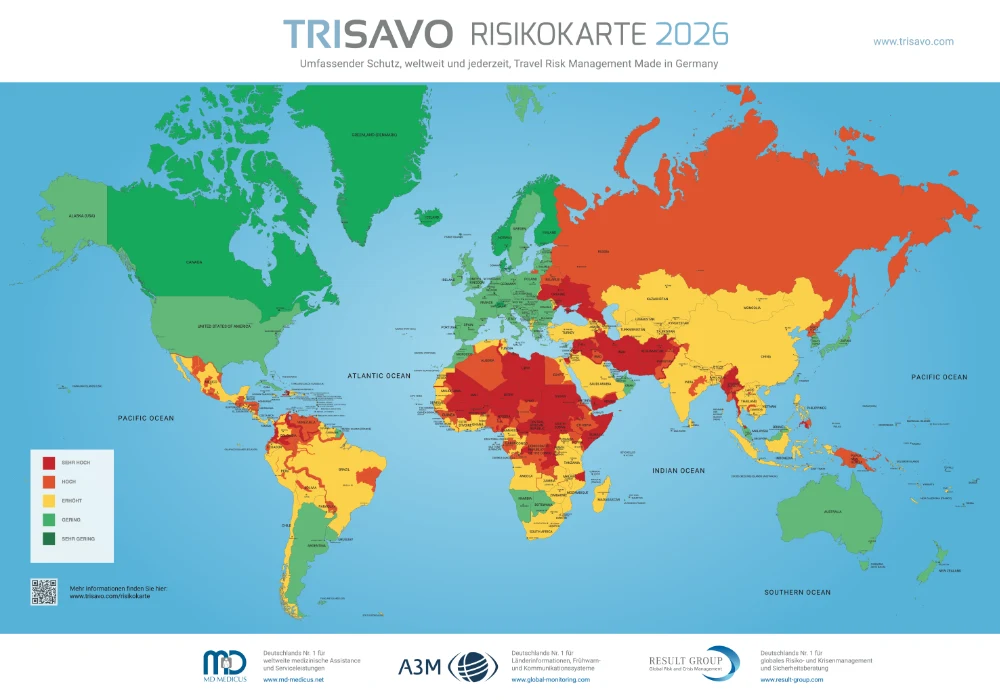
The TRISAVO risk classifications They offer an initial overview of the conditions in different countries. The scale ranges from dark green for stable conditions to dark red for regions with significantly increased risk. This provides companies with a structured introduction to planning international activities and can corresponding Precautionary measures derive.
 DE
DE